Opinion / British Television / Timeless Television
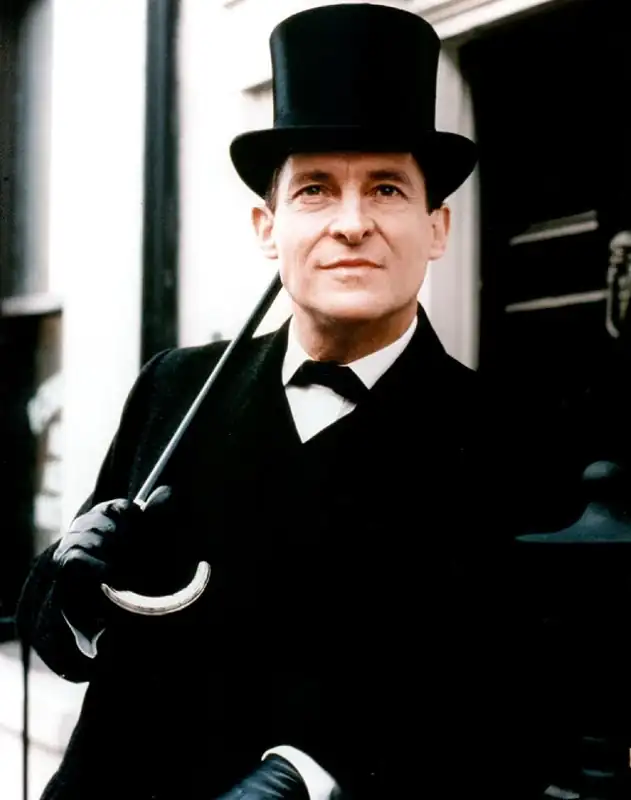
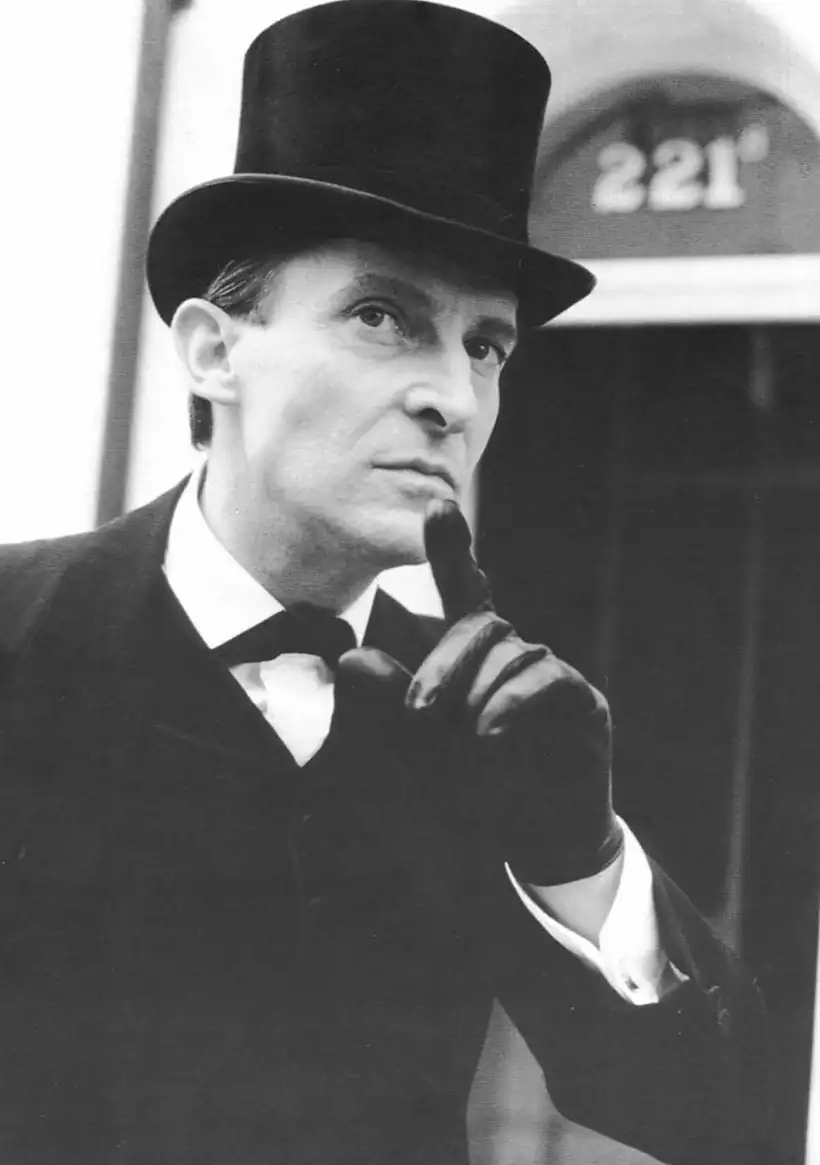
Jeremy Brett — The Gaze That Became Sherlock Holmes
A tribute to an extraordinary actor, an unforgettable Victorian world, and a performance that has stayed with me for a lifetime.
Spoiler note: This essay discusses the endings of “A Scandal in Bohemia” and “The Blue Carbuncle”.
I was little when my mother watched The Adventures of Sherlock Holmes on television. I loved the mysteries, the investigations and the way Holmes could look at something everybody else had seen and find a question nobody else had thought to ask. I wanted to know how he did it. I was also fascinated by the way Jeremy Brett looked at people. I could have told you what Holmes had discovered in a story. I would have had a much harder time telling you what I saw in his face.
There was something arresting about the contrast between those eyes and the rest of him. A man could look that intently at another person and still give away very little of himself. As a child, I understood the first part perfectly well. It took me years to recognise how much the second part had to do with his appeal.
Granada’s series began in 1984, before I belonged to its audience. By the time I knew how many actors had played Sherlock Holmes, Jeremy Brett had already settled the question for me.
The attraction of an extraordinary mind
One thing I can say now, which would have bewildered me as a child, is that I already found Holmes attractive. Intelligence has always been one of the qualities I find most attractive in men, and Brett gave it a physical presence. The line between a man who knows he’s clever and a man who is enjoying being clever is one he crosses with relish.
Then there was the distance. Holmes can give someone his undivided attention without making himself available in return. That’s a disconcerting quality in a person and a fascinating one in a character. You can imagine wanting to be the person who makes him look up. It’s considerably harder to imagine what you would say once he did.
Which brings me to Irene Adler. In Conan Doyle’s “A Scandal in Bohemia”, the King of Bohemia hires Holmes to recover a photograph that could compromise his marriage plans. Disguised as a clergyman, Holmes arranges a false alarm to make Irene reveal where she keeps it. He reads her correctly in that instant. She subsequently recognises the deception, follows him in disguise and leaves before he can return for the photograph.
I’ve never felt the story establishes that Irene is Holmes’s intellectual equal across the board. What interests me is the particular advantage she takes from him. Holmes is accustomed to knowing who everybody is while remaining free to decide how much of himself they see. Irene recognises him through his disguise and passes him in hers. By the time he returns, she has gone.
The detail I love is that Holmes asks to keep her portrait. After an investigation about who gets to possess a photograph and what they can do with it, he chooses the one Irene has left of her own accord. Watson explicitly distances Holmes’s regard from conventional romantic love in Doyle’s story. That leaves room for the quality I find most intriguing about her place in his life. She has disturbed his confidence in his own invulnerability. For once, someone else has decided what he gets to see. [1]
The anatomy of a gaze — how Brett made intelligence visible
By the time Brett played Holmes, he had played Hamlet and worked in Laurence Olivier’s National Theatre company. He had also played Watson opposite Charlton Heston in The Crucifer of Blood. In his own account of playing Holmes, he described having to restrain his sociable personality to inhabit someone more self-contained. That makes the reserve which fascinated me as a child seem all the more considered. [2, 3]
There is a revealing description in Rosemary Herbert’s interview with Brett, first published in 1985. Over breakfast, she watched him demonstrate Holmes by changing his face and posture. The transformation was brief, achieved without make-up. Then his own smile returned. Her account puts something concrete behind the impression I remember. A gaze belongs to the whole face and body. The same eyes can suggest very different relationships with the person opposite them. [4]
Brett also used a panther as a model for Holmes’s movement. The image suggests contained energy and a body organised around its next action. [5]
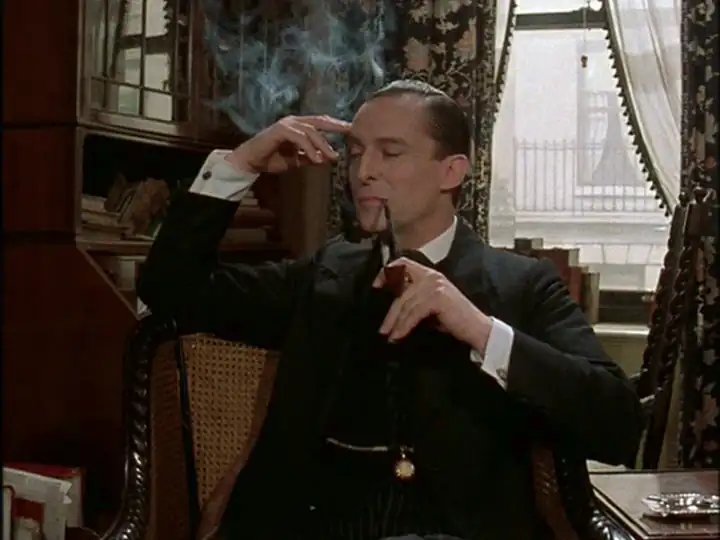
What fascinates me is the intelligence implied by that containment. Doyle can let Watson tell us that Holmes is absorbed in a problem. An actor has to make absorption readable while giving the audience a reason to keep watching. Brett’s expression offers the possibility of a thought we have not yet been allowed to hear. His reserve gives the eventual explanation somewhere to come from.
“A Scandal in Bohemia” makes that problem especially interesting because Holmes is himself performing. In the false-alarm sequence, the apparently injured clergyman asks for air, helping to secure the open window the scheme requires. Once the smoke appears, he offers an explanation for it. Each exchange has an immediate purpose inside Holmes’s larger plan. Outside, he tells Watson he knows where the photograph is and intends to return the following morning. [6]
Brett’s own explanation adds an illuminating complication. Discussing this episode with Herbert, he described Holmes’s disguises as an escape from himself. He also interpreted the encounter with Irene as a moment when sensory awareness unsettles the detective’s control. This is Brett’s account of what he was trying to play, and it gives the scene a tension beyond a successful trick. Holmes can direct the encounter while remaining susceptible to it. [4]
That interpretation matters to the attraction I find in him. The possibility of disturbance makes the composure interesting. An actor who merely supplied an inscrutable face would give us very little to return to.
What Brett does with a hat
Brett recalled taking Doyle’s stories into rehearsal and arguing for their place in the adaptation. Granada’s willingness to spend time on a battered hat shows what that commitment could make possible. Cutting the conversation to reach the stolen jewel faster would cost us some of the best company in “The Blue Carbuncle”. [3]
Peterson, a commissionaire, brings Holmes the hat and a Christmas goose. The goose goes home with Peterson. The hat stays. Holmes draws Watson’s attention to its fine lining, the broken elastic and the candle stains. Then he gets from a dusty brim to the state of its owner’s marriage. I’d trust him to examine my hat. I’m less sure I’d ask him what it said about my prospects at home.
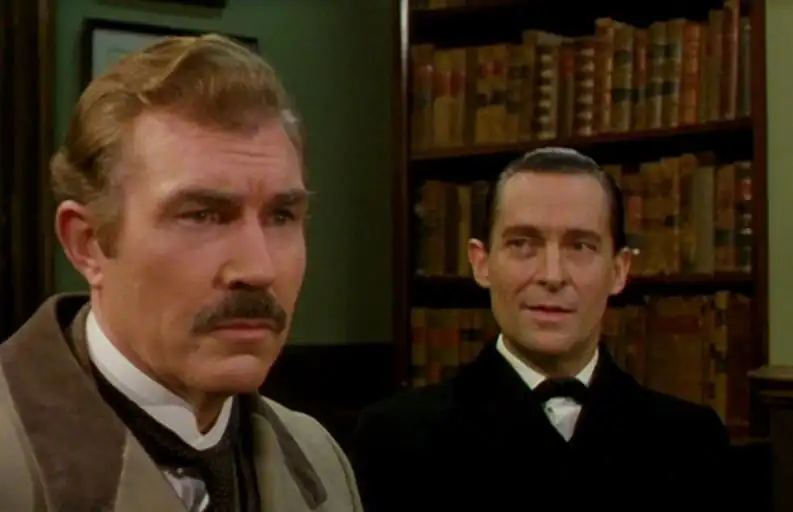
David Burke’s Watson has questions. Some deductions can be explained by pointing to evidence on the hat. Others invite a reasonable objection. Holmes’s conclusion about the owner’s wife, for instance, depends on assumptions Watson is entitled to examine. Their conversation gives the audience permission to enjoy the reasoning and find Holmes rather pleased with himself.
The writing gives Brett two things to negotiate at once. Holmes wants to explain what he has noticed, and he wants Watson to appreciate the explanation. Intelligence becomes a social encounter, with all the opportunities for amusement that brings.
At the end, Holmes has recovered the jewel, and the two men are about to eat. Watson says he cannot contemplate supper while John Horner, the man wrongly accused of the theft, is still being held. Holmes agrees, and they leave. After the elaborate reasoning earlier in the episode, the remaining obligation takes only a few words to establish. Watson has seen what still needs doing. [7]
A London I can go back to
When I put on an episode almost at random, I’m choosing the company of an entire world. The Baker Street set stood at Granada’s Manchester studios. The Sherlock Holmes Society of London’s record of its 1987 visit includes the street and the interior of 221B, where “Wisteria Lodge” was in rehearsal. Looking at that record, it is easy to understand how much practical work went into making a place that could feel so familiar. [8]
Patrick Gowers’s music belongs to that familiarity. His score helps establish a world in which curiosity can turn unsettling, and where the warmth of Baker Street exists within reach of something less reassuring outside. Its pull is part of what brings me back before I have chosen which mystery I want to revisit. [9]
The period detail matters because people have uses for these things. A worn hat can tell Holmes what its owner could once afford. A goose can lead him into the business of buying Christmas dinner. When Henry Baker calls to collect his belongings, Holmes offers him a replacement bird and mentions that the remains of the original are available. Baker wants the fresh goose. Holmes learns something from the choice, and Baker recovers a meal he had expected to lose.
Baker also explains why he did not advertise for his property. Money is scarce, and he thought recovering it unlikely. The conversation allows an ordinary financial calculation to matter alongside an extraordinary jewel. Mrs Hudson, meanwhile, has an equally sound reason to care about what happens to supper. [7]
Knowing the solution leaves all of this available. The mystery has other pleasures besides the concealment of a name. A visitor still has to tell his story, Watson can still question an inference, and Holmes still has to persuade somebody to answer him. These are substantial reasons for enjoying the series as an adult. The atmosphere I return for is made from those encounters as much as from the street and the music.
The man who put on a red sweater
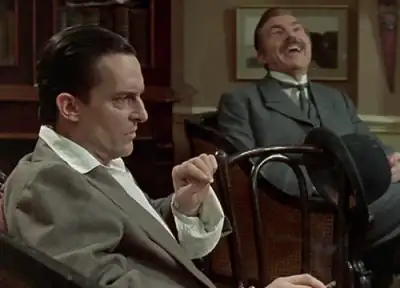
After filming, Brett washed his hair and wore a red sweater to shake off Holmes. It is an ordinary, memorable detail of an actor’s working life. [5]
His second wife, the television producer Joan Wilson, died in 1985. In September 1995, Brett spoke publicly about his bipolar disorder in a BBC Radio 4 appeal. He described his admission to hospital in 1986 and explained why he wanted to speak about it. His professional success had given him the courage to discuss an illness he hoped others would understand could be treated and managed. [2, 10]
Brett died on 12 September 1995, nine days after that broadcast. There is something moving about his choice to use a public platform to offer practical encouragement. It lets us hear the actor as someone with concerns and responsibilities beyond the character whose face had become so widely recognised. [2, 10]
His dedication also survives in the accounts of rehearsal, in his explanations of difficult scenes and in the recollection of an interviewer watching him become Holmes over breakfast. Those are working details, and they bring the achievement closer. An expression can seem inevitable to a viewer who has known it since childhood. Behind it was a professional making choices.
The way back to Baker Street
I’m thirty-eight now. Every few years I go back to the Granada series. Sometimes I watch it from beginning to end. Sometimes I choose an episode almost at random. I also listen to Sherlock Holmes audiobooks, both Doyle’s original stories and adaptations. The literary world has continued alongside Brett’s interpretation, giving me other ways into stories that have occupied so much of my life.
I can see now that some of what I felt as a child was attraction. The intelligence, the distance, that extraordinary gaze: I had noticed them before I knew what to call the feeling. Understanding it has added something to the pleasure of watching him.
There is no single episode that explains why I return. It is the mysteries, the atmosphere and Brett’s presence within that world. Across the years, they have remained worth my attention.
I was little when my mother watched him on television. The girl who wanted to know how he solved the case and the woman who returns for his company have had different reasons to look at him. When I hear the name Sherlock Holmes, the face that comes to mind is still his.
Sources & Further Reading
- Arthur Conan Doyle, “A Scandal in Bohemia”. Original text, including Irene’s letter and Watson’s account of Holmes’s regard for her. Read the story
- Derek Granger, “Obituary: Jeremy Brett”, The Independent, September 1995. Theatre career, Joan Wilson and date of death. Read the obituary
- Kevin P. Murphy, interview with Jeremy Brett, 6 November 1991. Interview transcript with its provenance explained in the introduction. Covers rehearsal, Doyle, Watson and Brett’s approach to Holmes. Read the transcript
- Rosemary Herbert, interview with Jeremy Brett, The Armchair Detective, autumn 1985. Excerpts republished by Murder & Mayhem in 2017. Firsthand description of Brett demonstrating Holmes and his account of the Irene Adler sequence. Read the interview excerpts
- “Stalking Sherlock”, The Washington Post, November 1991. Contemporary interview documenting Brett’s animal-movement reference and red-sweater anecdote. Read the interview
- “A Scandal in Bohemia”, Granada adaptation. Publicly available English subtitle transcription, consulted for dialogue and sequence of events. Read the subtitles
- “The Blue Carbuncle”, Granada adaptation. Official ITV episode listing and publicly available English subtitle transcription. ITVX episode guide · Read the subtitles
- Sherlock Holmes Society of London, “1987 — A visit to Granada Studios”. The Society’s account and photographic record of its visit. View the record
- Patrick Gowers, Sherlock Holmes original television soundtrack. Distributor’s record of the score and recording. View the soundtrack details
- Bethlem Museum of the Mind, “Telling Admissions 6”. Reproduces Brett’s account of his illness from his BBC Radio 4 appeal of 3 September 1995. Read the museum’s account
THE EPISODE EDIT / DISCUSSION
Reader comments
What brings you back to Jeremy Brett’s Sherlock Holmes?
Comments are anonymous and appear after editorial review. Please keep personal details out of your comment.